Explore the Moon in 3D
Spin the whole globe — the near side, the hidden far side, the maria and craters — built from real NASA imagery.
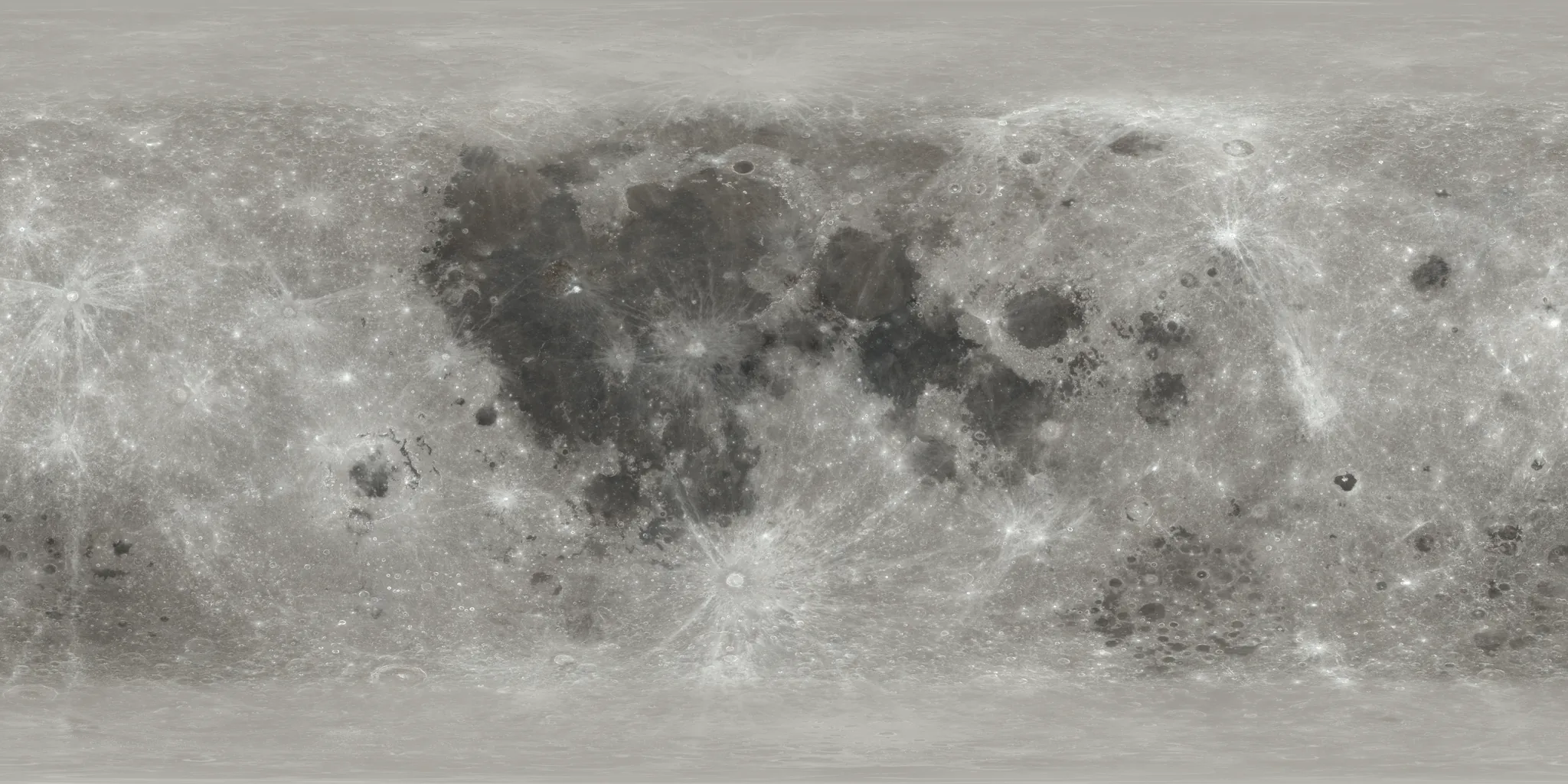
Drag to rotate · scroll or pinch to zoom · tap a marker
The near side and the far side
The Moon is tidally locked — it turns once on its axis for every orbit of Earth, so the same near side always faces us. Rotate the globe past the eastern limb and you reach the far side, unseen from Earth until 1959 and covered in dense, bright highlands with almost none of the dark maria that mark the face we know.
Apollo landing sites
All six crewed Apollo landings touched down on the near side — the hemisphere that always faces Earth. Spin the globe to find each one.
-
Apollo 11 1969
The first crewed landing, in Mare Tranquillitatis — Armstrong and Aldrin, July 1969.
-
Apollo 17 1972
The last crewed landing, in the Taurus–Littrow valley — the longest stay on the Moon.
-
Apollo 15 1971
Landed at Hadley Rille on the edge of Mare Imbrium; first mission with the lunar rover.
-
Apollo 12 1969
A pinpoint landing in Oceanus Procellarum, beside the earlier Surveyor 3 probe.
-
Apollo 14 1971
Landed near Fra Mauro; Alan Shepard famously hit two golf balls here.
-
Apollo 16 1972
The only landing in the bright lunar highlands, on the Descartes plateau.
The lunar maria
The dark patches are maria (“seas”) — vast plains of ancient basalt that flooded giant impact basins. They make up the face of the “Man in the Moon”.
-
Mare Tranquillitatis
The Sea of Tranquillity — a vast basalt plain and the site of the first Moon landing.
-
Mare Imbrium
The Sea of Showers — one of the largest impact basins on the near side.
-
Mare Serenitatis
The Sea of Serenity, ringed by mountain ranges — easy to spot with the naked eye.
-
Mare Crisium
The Sea of Crises — an isolated dark oval near the Moon’s eastern limb.
Craters & rays
Sharp, bright craters mark younger impacts. The youngest fling rays of pale ejecta across the surface, easiest to see at full moon.
-
Tycho
A young crater whose bright rays splash halfway across the Moon — striking at full moon.
-
Copernicus
A textbook impact crater with terraced walls and a central peak, 93 km across.
-
Kepler
A small but brilliant rayed crater in Oceanus Procellarum.
Frequently Asked
Why do we only ever see one side of the Moon?
The Moon is tidally locked to Earth: it spins on its axis in exactly the time it takes to orbit us once, so the same near side always faces Earth. The far side was never seen until the Soviet Luna 3 probe photographed it in 1959.
What is the “dark side” of the Moon?
There is no permanently dark side — every part of the Moon gets sunlight over a lunar day. The “dark side” is really the far side: the hemisphere we never see from Earth. It looks strikingly different, with thick cratered highlands and almost no maria.
Where did the Apollo missions land?
All six Apollo landings were on the near side, mostly near the equator on the maria and highlands: Apollo 11 in Mare Tranquillitatis, Apollo 15 at Hadley Rille, Apollo 17 in the Taurus–Littrow valley, and others in Oceanus Procellarum and the Descartes highlands.
Are the textures real?
Yes — the globe is wrapped in NASA’s Scientific Visualization Studio “CGI Moon Kit”, built from Lunar Reconnaissance Orbiter imagery and LOLA elevation data. It is public-domain NASA data.